BUYING STOCKS · TOTAL COST
What buying US stocks on Binance actually costs, end to end
Most people watch the 35 cents and never notice they paid ten times that on the conversion step. This walks the whole path, in order, from money in your bank to a share you own and back again.
WHAT THIS COVERS
- Where the money gets cut
- The platform fee, the one that is written down
- The conversion spread, which is usually the big one
- The bid-ask gap on the fill
- While you hold: ADR fees and dividend withholding
- The return leg
- A full round trip with numbers in it
- The rest of the published fee table
- What we could not find
- Using this
The short answer: for most people the largest cost is not the platform fee. It is the spread on turning local currency into stablecoin. The platform fee settles at 0.1% on larger orders. The conversion spread often runs 0.5% to 1%, and it appears on no fee schedule anywhere.
Where the money gets cut
Between your bank account and a share you own, and back again, these are the points that take something:
Local currency to holding, and back
| Step | What you pay | Rough size |
|---|---|---|
| Local currency → stablecoin | The merchant's spread on P2P | Commonly 0.5%–1%, wider in volatile markets |
| USDT → USDC, if needed | Spot spread plus spot fee | Usually under 0.2% combined |
| Placing the buy | Platform fee | USD 0.35 at or below USD 340; 0.1% above |
| The fill itself | The bid-ask gap | Depends on liquidity; tight in regular hours |
| While holding, ADRs only | Depositary fee | $0.01–$0.03 per share, once or twice a year |
| Receiving a dividend | US withholding | 30% statutory for non-residents; treaty rates may be lower |
| Placing the sell | Platform fee, same rule | As above |
| USDC → local currency | The merchant's spread again | Same order of magnitude as the entry |
Two rows on that table appear on no fee page at all: the conversion spread and the bid-ask gap. They are not called fees, but they leave your money all the same. Most articles about Binance stock fees cover only the third row, which is where the gap in the public information sits.
On no fee tablePublished feeNo charge here
- Local currencyStart
- Stablecoin, P2PMerchant spread · commonly 0.5%–1%
- USDC, spot marketSpot spread + fee · under 0.2% combined
- Buying the stockPlatform fee · $0.35 at or below $340, then 0.1%
- The fill itselfThe bid-ask gap
- SellingPlatform fee · same rule
- Back to local currencyMerchant spread · paid a second time
The platform fee, the one that is written down
From Binance's published stock trading fee terms:
- Order value at or below USD 340: a flat minimum platform fee of USD 0.35.
- Order value above USD 340: the minimum drops away and 0.1% of the order value applies, rounded up to two decimals.
As a percentage the shape is stark. Twenty dollars pays 1.75%; a hundred pays 0.35%; a thousand pays 0.1%. Same stock, and the small order pays more than ten times the rate.
USD 340 is where Binance draws the line. It is not the exact break-even: 0.1% of 340 is 34 cents, one cent under the 35-cent minimum, and Binance simply cuts there. Below it you pay a fixed 35 cents and the rate climbs as the order shrinks; above it the rate locks at 0.1%. Accumulating and buying once is a different cost structure from splitting into ten small buys, not a smaller version of the same one. The order cost calculator gives you the number for your size.
These numbers move
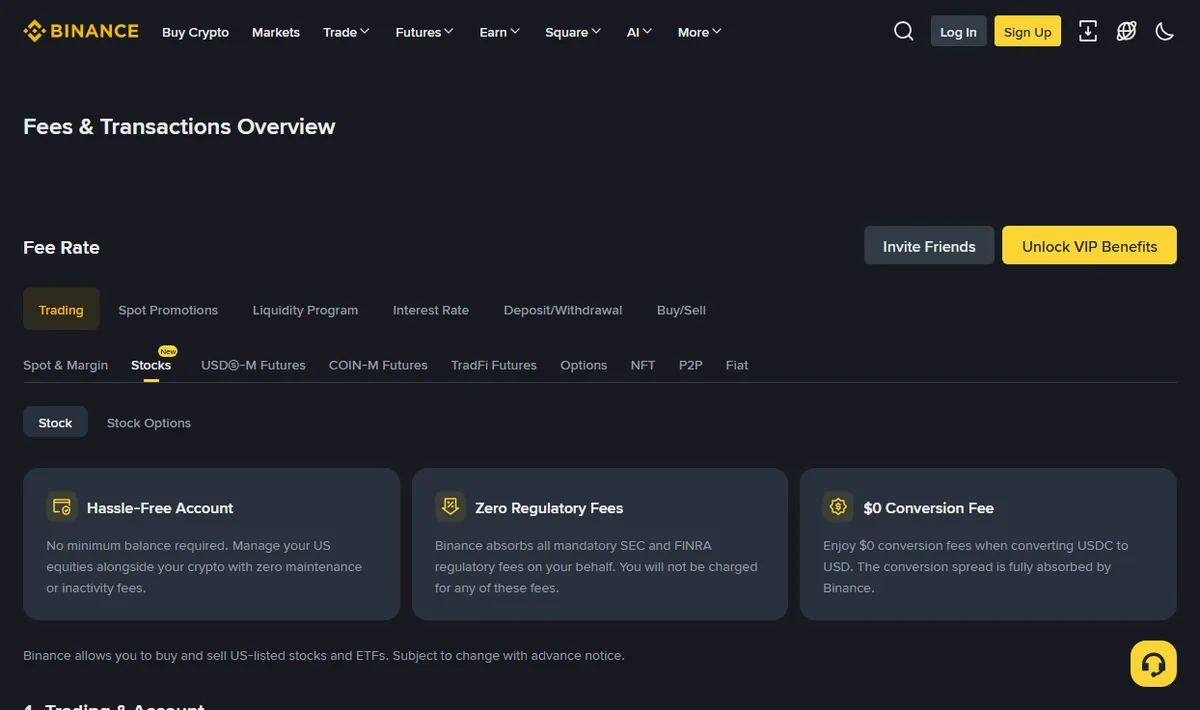
The rules above were checked in August 2026. Fee structures change without much notice, so what the Binance fee schedule shows at the time is what governs, and stocks sit on their own tab there. The product itself — settlement currency, minimum, fractional shares — is described on the stocks product page.
The conversion spread, which is usually the big one
This is the part worth your attention.
Buying stablecoin peer to peer, the merchant does not charge you a separate fee. Their margin is already inside the price they quote. It shows up on no statement. You only see it if you compute it.
How to work out what you actually paid
Divide the local currency you handed over by the stablecoin you received. That is your real rate. Compare it against the published rate that day, and the gap is what this step cost you.
Worked example. Say the published rate that day is 1 USDT to 3.673 dirhams, you pay 3,700 dirhams, and you receive 1,000 USDT. Your real rate is 3.70, which is about 0.73% above the market. On a thousand dollars that is USD 7.30 — against a platform fee of USD 1.00 on a stock order of the same size.
The conversion cost seven times the platform fee. Which is why optimising the 35 cents is aiming at the wrong target.
Bringing it down
- Compare, but not on price alone. A merchant with a long completed-order record is worth a slightly worse rate; the real risk on this leg is not price but a flagged receiving account, covered in what you are actually risking on the P2P leg.
- Avoid volatile hours. Merchants widen their spread when the market moves, because that spread is their hedge, and you pay for it.
- Log every one. Date, local amount, stablecoin received, published rate that day. After five you know your own average, which beats any guide.
If you bought USDT
Stock orders settle in USDC. Holding USDT, you either swap on the spot market yourself or let the system convert when you place the order.
Swapping yourself costs a spot spread plus a spot fee, usually under 0.2% together, and you see the price while you do it. Letting the system convert is easier and gives you no control over the rate. On small amounts the difference is noise; on large ones it is worth the click. Full comparison in USDC or USDT.
The bid-ask gap on the fill
This one is quieter still: nothing is deducted from your balance. Instead your fill lands slightly worse than the price you were looking at.
At any moment there is a highest price someone will pay and a lowest price someone will sell at, with a gap between them. A market buy fills on the ask side, a market sell on the bid side. That gap is the cost.
- Regular hours, 9:30 to 16:00 US Eastern, have the most participants and the tightest gap.
- Pre-market, after-hours and the 24-hour window have fewer, and the gap widens noticeably.
- The minutes after an earnings release can blow it open entirely.
There is one way to control it: use a limit order when the book is thin, fencing in the price you accept, at the cost of possibly not filling. Which session calls for which order type is in the sessions piece.
While you hold: ADR fees and dividend withholding
ADR depositary fees
If what you hold is an ADR — the form non-US companies use to list on US markets — a depositary bank charges a fee on top of dividend tax. The published table puts it at $0.01 to $0.03 per share, listed as a pass-through cost, typically collected once or twice a year.
That is a depositary charge, not a platform one, and ordinary US shares do not carry it.
Dividend withholding
US withholding on dividends to non-residents comes off at source, statutorily 30%. Those who qualify can claim a treaty rate through a W-8BEN-type form; which rate applies turns on your tax residency and the specific article, and varies enormously. The mechanics are in the dividends piece.
Whether to count it as a cost depends on your framing: it removes part of a return rather than taking money you already had. But if you bought for the income, ignoring it inflates your expectation by roughly a third.
The return leg
The platform fee on the sell side follows the same rule as the buy: USD 0.35 at or below USD 340, 0.1% above.
The proceeds are not immediately movable. US equities settle T+1, and until that completes the USDC can trade spot or buy more stock but cannot be withdrawn. That is a time cost rather than a fee; the timeline is in settlement and withdrawal.
Then the last leg: USDC back to local currency, peer to peer again, with you as the seller. The spread there is the same order of magnitude as the entry, which means a full round trip pays the conversion spread twice.
This leg also carries a risk the entry does not: the money arriving may have a problematic origin and leave your receiving account flagged. That is a hassle problem rather than a price one, covered in the P2P risk piece.
A full round trip with numbers in it
Assume a round trip of about USD 1,000, using the 0.73% conversion spread from above and the current platform fee rules.
Round trip on roughly USD 1,000 (illustrative, not a trade record)
| Step | Cost in USD |
|---|---|
| Local currency → USDT, spread about 0.73% | about 7.30 |
| USDT → USDC, swapped yourself, about 0.15% | about 1.50 |
| Buy USD 1,000, platform fee 0.1% | 1.00 |
| Bid-ask on the buy, large cap in regular hours, about 0.05% | about 0.50 |
| Sell USD 1,000, platform fee 0.1% | 1.00 |
| Bid-ask on the sell | about 0.50 |
| USDC → local currency, spread about 0.73% | about 7.30 |
| Total | about 19 ≈ 1.9% |
The line worth reading is the total. Of roughly nineteen dollars, the platform fee accounts for two and the conversion spread for nearly fifteen. Around three quarters of the cost happens at the two steps that advertise no fee.
Put differently: the price has to rise about 1.9% before that round trip breaks even. Halve your conversion spread and the round trip drops to roughly 1.2% — more than you could ever save on the platform fee.
Illustrative, not a promise
The 0.73% conversion spread and 0.05% bid-ask are example magnitudes. Your real numbers depend on the merchant you pick, the market that day and the instrument you buy. The platform fee lines follow the currently published rules, which can be adjusted. Run it again with your own figures; that is the version that means something.
The rest of the published fee table
Everything above is what you will almost certainly meet. The fee table carries a further list, most of it $0.00 — which is not filler, because several of those lines are things a traditional broker does charge for, and you cannot compare the two routes without them. Two other lines are real money, sitting where nobody thinks to look.
The remaining lines (checked September 2026)
| Item | You pay | Worth noting |
|---|---|---|
| Account opening / maintenance / inactivity / custody | $0.00 | No fixed account fee, and none for sitting still |
| SEC transaction fee (sell side) | $0.00 | Underlying rate $20.60 per $1,000,000 of proceeds; absorbed |
| FINRA trading activity fee (sell side) | $0.00 | Underlying $0.000166 per share, capped at $8.30; absorbed |
| Consolidated Audit Trail fee | $0.00 | Absorbed |
| USDC ↔ USD conversion | $0.00 | The spread on that leg is absorbed too |
| Dividend processing | $0.00 | Automatic; what gets deducted is US withholding, not a platform fee |
| Mandatory corporate actions | $0.00 | Splits, mergers and the like, handled automatically |
| Voluntary corporate action | $200.00 | Per election |
| DTC transfer out | $100.00 | Per security per submission; ACATS not supported |
When the two expensive lines actually bite
A voluntary corporate action is when the company offers shareholders a choice — take part in a tender offer, subscribe to a rights issue — and you elect to participate. Two hundred dollars a time. Most people holding large caps for years will never meet it, but if a company you hold runs one and you want in, the fee can exceed the amount you were going to put in. Work that out before, not after.
DTC transfer out is moving the shares elsewhere: 100 dollars per security, and the page states plainly that ACATS is not supported — that being the standard broker-to-broker account transfer. Easy to enter, expensive to move the shares themselves out. The full discussion is in Binance stocks versus a traditional broker.
Do not read those $0.00 lines as nothing.
Regulatory fees are normally passed on to you at a traditional broker, and plenty of brokers do charge maintenance and inactivity fees. The page says so itself at the foot: the SEC and FINRA set those rates, they can move without Binance giving notice, and at present Binance absorbs them. "At present" is their word, not ours. The original table sits on the page in the screenshot above, under "Other Fees".
What we could not find
Two things are not spelled out in the material we could locate, so we are not going to guess at them:
- How small residual balances are handled. After selling a fractional share you may be left with a few cents of USDC. Whether there is a floor, or any sweep, is not clear in the public terms.
- How a residual balance is actually cleared. The point above is whether a floor exists; this one is whether the remainder gets swept, and at what price. The public terms do not say.
Either those rules do not exist yet, or they live somewhere we did not reach. If your usage will run into them, ask official support rather than inferring from any article, this one included. Account and product terms are governed by the current version of Binance's terms of use.
Using this
For a number on your own order size, the order cost calculator. For how to place it, your first order. For bringing the conversion step down, turning local currency into USDC.