BUYING STOCKS · HOW-TO
How to buy US stocks on Binance: fractional, market, limit
Account open, funds in place. Technically the order is the easy part, but two choices here directly shape your result: how much, and how you buy.
Short version: make the first one a limit order, and do not make it tiny. Market orders in thin sessions can fill somewhere you did not intend, and below 340 dollars the fixed minimum platform fee pushes the effective rate up hard.
WHAT THIS COVERS
Fractional shares: possible does not mean advisable
The minimum is five dollars and fractions are supported, which means you do not need to fund an entire share of a several-hundred-dollar stock to participate.
What you end up holding is an ordinary US-listed share rather than a platform-specific product, so the usual rules around stocks as an asset class apply: dividends, splits, session hours and all.
For beginners that is genuinely useful, since it is cheap to experiment and diversification is possible with small sums. But one thing does not scale down with your order: the cost structure.
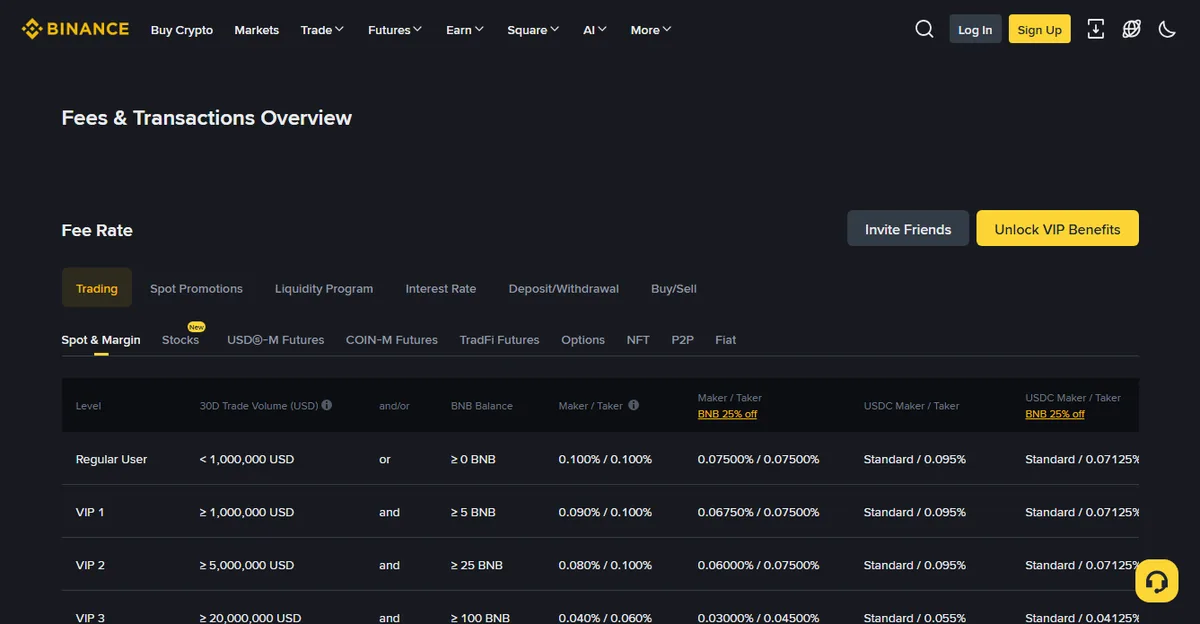
At or below 340 dollars you pay a flat 0.35 dollars. Above it, 0.1%. (Tiers and figures checked 2026-08; Binance can change them, so read the live fee page before you order.) So five dollars pays 7%. Twenty dollars pays 1.75%. Exactly 340 dollars pays 0.1%, the point where the two tiers meet.
Which means fractional shares and low cost are separate things. Fractions solve "I cannot afford a whole share". They do not solve "small trades are expensive". Check where your order lands with the cost calculator, and see what else you pay besides that fee in the full cost breakdown.
A more practical pattern
If the plan is regular investing, 200 to 340 dollars once a month beats 50 dollars once a week. Identical annual contribution, several times better on fees. Acting less often has a second benefit too: fewer opportunities to react to noise.
Market versus limit
A market order fills now at whatever the market offers. A limit order fills only at your price or better. That is the textbook; the choice depends on context.
Market orders are fine, until liquidity is not
In regular hours, large-cap spreads are tight and a market order fills close to what you saw. The problem appears when the book is thin — pre-market and after-hours, smaller names, or the first minutes after news. A market order there can eat several price levels and fill somewhere you would not have chosen.
This is not hypothetical, it happens daily. And the smaller your order, the more casual you tend to be about it, which becomes an expensive habit once the amounts grow.
Limit orders cost you certainty of execution
If your price is never touched, the order sits there. For someone in a hurry that is a drawback; for someone who is not, it is protection against buying badly in an impulsive moment.
Neither order type is a Binance invention. The SEC investor site has a short note on limit orders that describes exactly what the app is doing.
Use a limit order for the first one — not because it is cheaper, but because it makes the mechanics visible. Order placed, status changes, fill reported. A market order is done in a second and teaches you nothing about what happened.
Outside regular hours
There is a 24/5 arrangement and some tickers trade 24 hours. Convenient, and the source of a whole category of beginner mistakes.
- Spreads widen. Fewer participants, more distance between bid and ask. The "current price" you see may not be a price you can get.
- Moves are sharper. Thin volume means a modest order can push the price.
- Trade date attribution is easy to misread. An order you place late at night belongs to a session determined by the platform's convention, and that determines when T+1 starts counting.
So not "avoid those sessions". Rather, those sessions are exactly when to use limit orders. Session-by-session detail is in trading hours.
Three checks before you submit
Assets in the right account. Orders draw from funding or spot. Anywhere else and you get an insufficient balance message that has nothing to do with how much you hold.
The right instrument. Similar tickers are common, especially where a company has multiple share classes or where both an ADR and an ordinary listing exist. Check the full company name.
Your intended holding period. It determines whether T+1, dividend withholding and year-end records matter to you at all. Short and long horizons care about entirely different things here. What happens to your money after you sell is in settlement and withdrawal, worth reading before the first order rather than after.
Run the whole loop with a small amount
Buy, hold a few days, sell, wait for settlement, withdraw. The fees you spend buy certainty about your own path: how long each step takes, where it stalls. More useful than ten guides, and if something goes wrong you will be glad it was the small amount.
After the fill, look at three numbers
Most people glance at "filled" and close the screen. Three figures deserve a moment.
Fill price versus what you saw. With a limit order it should be your price or better. With a market order the gap is what immediacy cost you. Watch this number and you will develop a feel for which sessions are thin.
The platform fee actually charged. Compare it with what you expected. A mismatch means either the order crossed the 340 hinge or your arithmetic was off.
The quantity in your position. Fractions display as decimals. Converting an amount into a share count is an easy place to misplace a decimal.
On what to buy first
We do not answer that. Stock picking is outside what this site does, as set out in our editorial policy.
One platform-related note though: do not make your first trade an illiquid small-cap. Not because they are bad, but because thin books mean you are learning the mechanics and fighting wide spreads simultaneously, and you may draw the wrong conclusion, blaming the platform for fills that were really the instrument.
Run the flow once on something heavily traded, then go and research what you actually want.
A psychological trap worth naming
Fractional shares plus round-the-clock trading plus a phone in your hand puts the barrier to acting at nearly zero. Low barriers are good. They also mean there is no longer any friction between impulse and execution.
Opening an account, funding it, waiting for the open: that sequence used to function as a cooling-off period. Now the distance between reading something and having filled an order is about twenty seconds.
No clever solution, only a dull one: give yourself a rule, such as sleeping on anything unplanned. The opportunities that genuinely matter do not vanish overnight, and the ones that do were mostly not opportunities.
Sizing the first one
Two competing pressures: small enough that a mistake does not hurt, large enough that the fee does not distort what you learn.
A five-dollar order teaches you the interface while paying 7% in platform fee, which tells you nothing useful about economics. A 340-dollar order pays 0.1% but is more than many people want to commit while still learning.
A reasonable middle is somewhere around 100 dollars. The fee is 0.35 dollars, visible but not distorting, and the amount is small enough to treat as tuition.
Then leave it alone
The instinct after buying is to check constantly. Resist it, not for any mystical reason but because a few days of price movement contains no information, and watching trains you to react to noise.
What is worth checking after a few days is mechanical: does the position display correctly, did any corporate action occur, is the cost basis what you calculated. Those teach you something.
Selling for the first time
Do it deliberately, before you need to. Sell part of the position, watch the balances, and meet the settlement restriction first-hand.
Two things you will learn that no article conveys properly: how the interface distinguishes settled from unsettled funds, and how long the path actually takes on your setup. Both matter later, when there is real money and possibly a deadline involved.
The mechanics are in settlement and withdrawal, but reading and doing are not the same thing here.
My order did not fill. Why
This is what confuses limit-order users most: the order is sitting there, the price looks like it got there, and nothing happened.
Three reasons, in order of likelihood
One: the price touched but did not cross. You bid 100 dollars and the market dipped to exactly 100. That does not guarantee you a fill, because there is a queue at that price and you are not alone in it. Either the price moves further down, or you wait your turn.
Two: the price you are watching is not the price you match against. The "last price" on the chart is what someone else just traded at. Your buy order matches against the best ask. Those two numbers drift apart when liquidity is thin.
Three: session restrictions. Some order types are not accepted outside regular hours, or behave differently.
The interface usually warns you. The warning is the first thing people skip past.
Adjust the price or wait
It depends on why you chose that price. If it is a number you worked out for a reason, wait. If you just put in something a bit below the market with no reasoning behind it, waiting means nothing — you are only betting.
And repeatedly adjusting the price is the worst thing you can do. Each edit puts you at the back of the queue again, and you end up chasing the market up until you fill at a worse price than a market order would have given you in the first place.
First-order mistakes, collected
- A market order outside regular hours. The single most expensive beginner error.
- An order size just under the hinge. Paying 0.35 on 340 dollars is 0.103%, which is fine. Paying it on 40 dollars is 0.875%. Know which side you are on.
- Assets in the wrong account, then assuming the platform is broken.
- Starting with an illiquid name and blaming the fill on the platform.
- Never checking the fill, so never developing a sense of what a good one looks like.
None is catastrophic alone. Together they separate someone who learns the system in a week from someone still confused a month later.
When your limit order does not fill
The price touched but did not go through. If you bid 100 and the low was exactly 100, you are not guaranteed a fill; there is a queue at that level and earlier orders come first.
You are watching the wrong number. "Last price" is the previous trade. Your buy has to meet the current ask, and in thin markets those two differ.
Session restrictions. Some order types behave differently, or are unavailable, outside regular hours. The interface usually says so and people usually skip it.
Whether to amend or wait depends on why you chose that price. If it was reasoned, wait. If you just picked something under the current price, waiting achieves nothing. And amending repeatedly is the worst option — each change re-queues you, and you tend to chase upward anyway until the fill is worse than a market order would have been.