BUYING STOCKS · SETTLEMENT
Binance US stocks: when can you withdraw after selling?
A lot of people meet this only after selling: the balance is there, but moving it to a futures account or withdrawing it is refused. Nothing is broken. Settlement has not finished.
- T · you sell Filled. USDC appears in the balance. It is unsettled: visible, but limited in what it can do.
- T → T+1 · settling That USDC can trade spot and buy more stock. It cannot move to futures or margin, cannot be withdrawn, cannot go to fiat trading.
- T+1 · settled Restrictions lift. Now it is ordinary USDC: send it on chain, withdraw it, whatever you like.
- After · back to local currency If that is the goal, there is a P2P step still to come. Its duration and risk are set by the market, not by the settlement cycle.
WHAT THIS COVERS
First: there are two different T+1s on this route
Search for Binance and T+1 and most of what comes back is not this. Two separate T+1 rules sit on Binance, governing different steps. This piece is about the one on the right.
Two T+1s, biting at different moments
| The P2P funding T+1 | The stock settlement T+1 (this piece) | |
|---|---|---|
| When it hits | After buying crypto with local currency on P2P | After selling a stock |
| What it restricts | Withdrawal — moving coins off Binance | Whether the sale proceeds can move |
| What it does not | Trading carries on | You can keep buying stocks or trading spot |
| Any exemption | Yes, a T+0 allowance | None |
| How it counts | 24 hours from order completion | Trading days, not calendar days |
The misunderstanding that costs people a day
You have just swapped local currency for USDC on P2P, the interface mentions T+1, and the natural read is that the money is frozen until tomorrow.
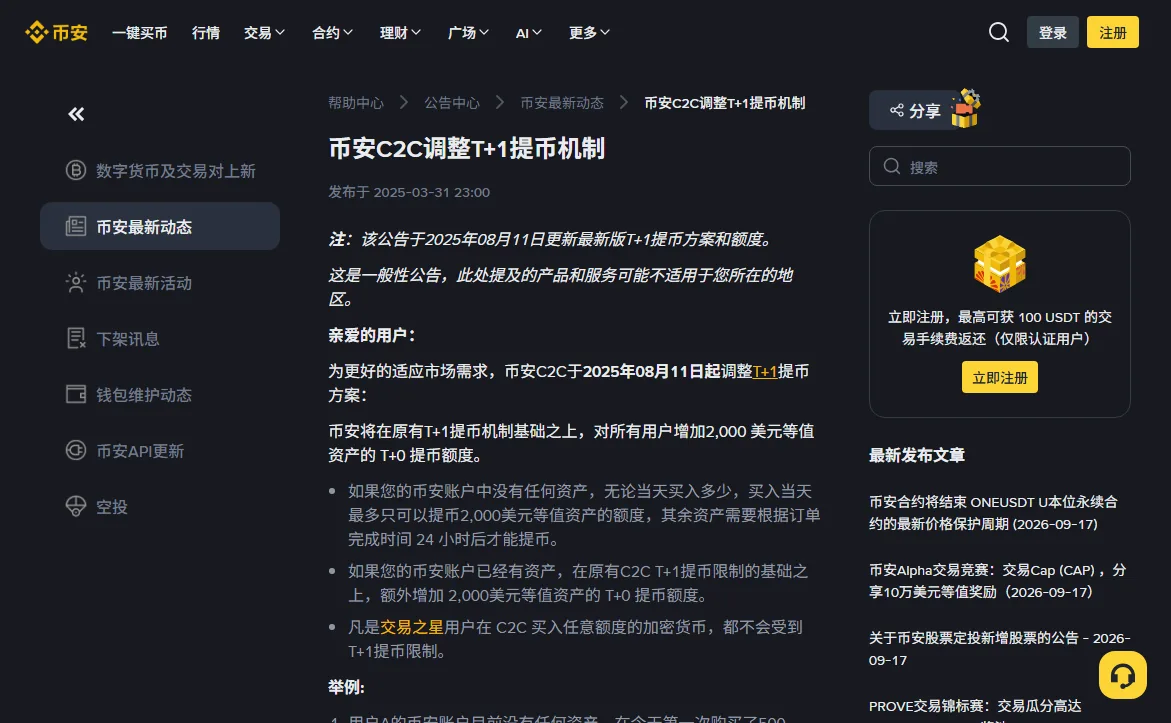
It is not. Binance's own announcement is explicit that trading activity — spot, futures and margin — is unaffected during that window. What is held back is moving coins off the platform, not spending them inside it. You can place a stock order the same day you fund.
The exemption works off whatever the current announcement says: every user gets a flat T+0 allowance, and anything above it waits 24 hours from when the order completed. That figure has already been revised once, from one thousand dollars' worth to two thousand. So do not commit a number to memory; what the announcement shows at the time is what governs (we checked in September 2026; the announcement was last updated 11 August 2025).
If your actual plan was to fund and withdraw the same day, that is a different matter — that is precisely the case this rule exists for.
A full round trip meets both
Local currency, buy crypto, buy stock, sell stock, convert back. The first T+1 governs whether you can pull coins out early on; the second governs when your sale proceeds become movable. They are unrelated and they do not stack. Confusing them costs you either a wasted day of waiting or an unpleasant surprise when the money you expected is not there.
Where T+1 starts counting
T is the trade date, not the second you pressed the button. Usually the same day, but the exceptions are exactly where confusion lives.
Regular hours run 9:30 to 16:00 Eastern, with a 24/5 arrangement on top and some names trading 24 hours. Fill outside regular hours and which trading day it belongs to follows the platform's convention. Across time zones this is easy to be a day out on.
Also: the "1" counts trading days. Sell Friday and the next is Monday; add a holiday and it stretches. Real waiting time can be one day or four. The SEC’s investor education site keeps a short entry on the settlement cycle. It is a market-wide rule, not something a platform imposed on you.
The practical consequence
If the plan is "sell the shares, convert straight back", do not put both on the same day, and especially not on a Friday. Build in slack rather than watching a clock later.
What unsettled money can and cannot do
Split apart, the logic is clear: while the money is still inside the securities leg, it can only move within securities and spot.
Allowed: buy other stocks, trade on the spot market, convert to another asset and hold it on the spot side.
Not allowed: transfer to futures, transfer to margin, withdraw on chain, use for fiat trading.
The design makes sense, because unsettled proceeds are still a receivable in transit, so they are not permitted to back leveraged exposure or leave the system. Regular brokers apply a comparable rule under different names.
Which is why "withdrawals are fast here" needs qualifying
Crypto withdrawals can be quick; that is a property of the chain. Money from a stock sale has to clear T+1 before it re-enters that fast world. Conflating the two produces the "why can I not withdraw" confusion.
Why T+1 exists at all
Knowing the origin beats memorising the rule, because it tells you this is not a platform restriction; it is how the equity market works.
The fill you see on screen is only agreement between two parties. Actual transfer of ownership and cash happens in clearing and settlement infrastructure that processes in batches and needs time to reconcile and net. Trade and settlement have never been the same moment, anywhere in the world. Only the gap differs.
The US has compressed that gap over the years, from T+3 to T+2 to T+1. Shorter means less capital tied up and less counterparty risk, but it cannot reach zero, because the process behind it takes time.
So this is not a Binance rule
Sell US equities at a regular broker and you also wait, and you also cannot freely redeploy before settlement; brokers typically distinguish cash balance from withdrawable cash for exactly this reason. Here it surfaces as "this USDC cannot go to futures or be withdrawn yet". Same cause, different wording.
Which also means: if you own real shares, you cannot avoid the settlement cycle. Anything claiming instant availability from an equity sale is either describing something else, or someone is fronting you the money.
Converting back: the risk flips direction
Once settled, if the destination is local currency, that is usually a P2P trade, with you as the seller this time.
Reverse the direction and the worry reverses too. Buying, you fear the seller not releasing. Selling, you fear the money you receive. Funds of problematic origin can leave your receiving account flagged or frozen. That risk is not on the platform's side, and choosing careful counterparties reduces the odds without removing them.
What genuinely helps: favour high-volume, high-completion merchants and keep the full record: order screenshots, chat, transfer receipts. Do not try to split amounts, rotate receiving accounts or reword the stated purpose to avoid review. Structuring transactions for that purpose is a distinct offence in many jurisdictions, and it weakens your position precisely when you need to explain where the money came from. Follow the order page, your bank and local law accurately, and stop to ask when the rules conflict. The residual risk is still yours to judge, which is why it is spelled out in our risk notice and at length in the P2P risk piece.
We would not plan spending against the settlement date. Leave a couple of days spare. Holidays and weekends turn “one day” into several, and getting that wrong once is enough.
If you genuinely need the money by a date
Which days the market is closed comes from the NYSE official calendar, which also marks the early-close half days that break most people's arithmetic.
Work backwards. From the day you need local currency, allow for the conversion, then the settlement trading day (skipping weekends and US market holidays), and only then pick the sell date. Do it in that order and you will not come up short. Our converter computes the settlement date for you.
More fundamentally: money you are certain to need soon does not belong in equities. Selling under time pressure also means accepting whatever price is available. Near-term spending and volatile assets should be different pots.
Walk the whole loop once, small
First time through, take a small amount all the way: buy, hold a few days, sell, wait for settlement, convert back. You will learn how long each leg actually takes on your particular path and where it stalls. Those fees buy certainty, which is worth more than reading about it.
Incidentally, the order leg of that round trip is the one you can price exactly in advance, since small and large orders differ sharply, and the cost calculator will show you by how much. How the whole route compares with a regular broker is in the comparison.
Reading the balances during settlement
The screen will show numbers that appear to disagree with each other for a day. They do not; they are measuring different things.
Total balance includes the unsettled proceeds. Available balance excludes what is still restricted. If you sold recently and those two differ, that gap is the settling amount, not an error and not a fee.
Worth knowing because it prevents a specific panic: people see the withdrawal screen refusing an amount their balance clearly contains, assume something has gone wrong, and start contacting support. Nothing has gone wrong. The calendar has not caught up.
What you can still do meanwhile
Quite a lot, actually. Unsettled proceeds buy other stocks and trade on spot, so if your intention was to rotate between positions rather than to withdraw, settlement barely constrains you. The restriction bites precisely when you wanted the money out.
Which suggests a habit: decide before you sell whether this is a rotation or an exit. If it is an exit, start the clock earlier than feels necessary.
Two edge cases people hit
Selling across a weekend. Friday fills settle Monday, so proceeds are locked through the weekend regardless of what the crypto side is doing. If your plan involved doing something with that money on Saturday, it will not work.
Selling before a holiday cluster. Late December is the reliable example: several closures inside two weeks can push availability out considerably further than the "T+1" label suggests. Check the date in our session converter, which skips non-trading days automatically.
The one-line version
Own real shares, live with settlement. Everything on this page follows from that. The platform did not choose it, cannot waive it, and any offer to bypass it is describing a different product or is lending you money.