FUNDING · FULL WALKTHROUGH
How to buy USDC on Binance P2P with local currency
Stock orders settle in USDC. What you hold is local currency. The bridge is P2P: Binance escrows the coin and arbitrates, but the money moves directly between you and another person. That distinction explains every risk on this page.
- 1Pick a counterpartyCompleted orders and completion rate matter more than price.
- 2Place the order — their coin gets lockedFrom here they cannot walk away, so you can pay without rushing.
- 3Pay using the details on the order pageOnly that account. Anything sent in chat is a red flag.
- 4Mark as paid, wait for releaseMark it only once the money has actually left your account — and do not cancel afterwards.
- 5Convert to USDC and move it into placeIf you bought USDT you have one more swap to do.
WHAT THIS COVERS
- Why this step exists at all
- Picking a counterparty: price matters least
- Paying: three sentences that mean stop
- After it arrives: getting to USDC
- The real cost of this step is not on any fee schedule
- Rhythm: do not fragment it
- The part that matters most is on the way out
- Four operational details people ask about too late
- If you have another funding route
- The money is in. What next
- Common questions
Why this step exists at all
Binance stock orders settle in USDC. You can hold USDT or BNB and the system converts at submission, but upstream you still need stablecoin from somewhere.
P2P is a matching market: another user advertises coin for sale, you pay them in local currency, and Binance locks their coin in escrow and handles disputes. Binance is not receiving your money. Once that is clear, every risk on this page follows logically, and nearly all of it sits with the counterparty rather than the platform.
Which payment methods are available: check, do not read
Rails differ by country and change over time. This page deliberately does not list them. Go by what your P2P page actually shows when you open it. Any guide with screenshots, this one included, can be out of date on that point.
Picking a counterparty: price matters least
The beginner instinct is to sort by price and take the best one. In practice the spread between merchants amounts to small change on a few-thousand-dollar trade, while picking badly can cost you days of dispute.
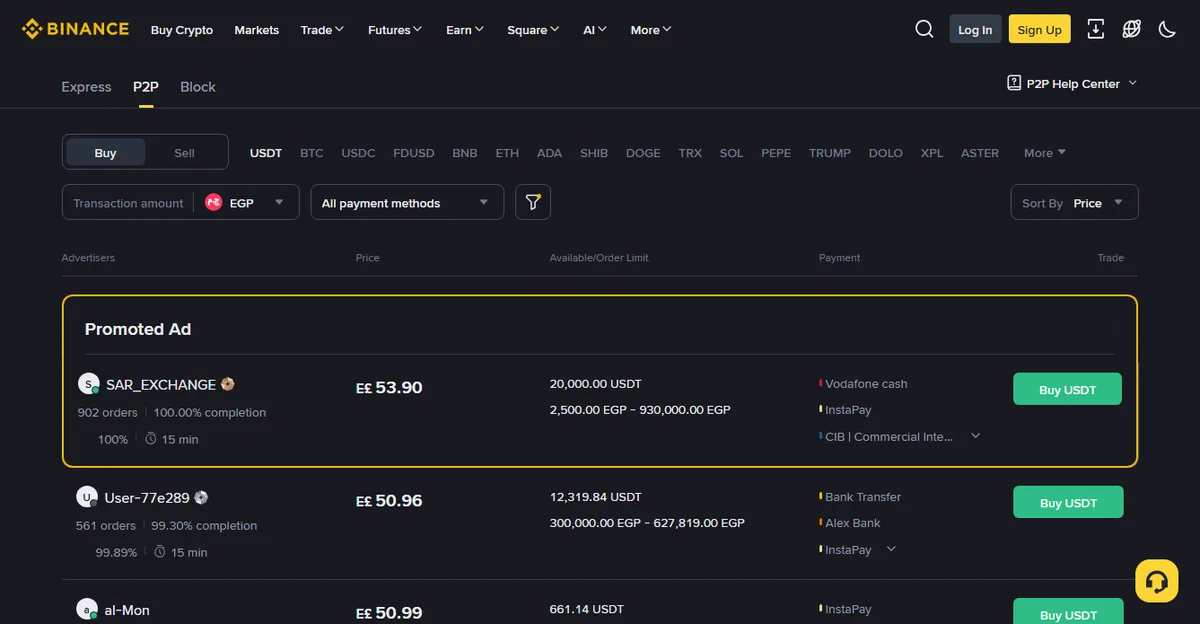
Three things, in order of importance:
- Completed orders. A high count means this merchant has been running a long time and has far more to lose from cheating you than they would gain.
- Completion rate. Anything notably below the norm is a warning: a meaningful share of their orders do not finish.
- Limits. Your amount has to fit inside their per-order range or you will be forced to split awkwardly.
Listings to skip outright
- A price conspicuously better than everything around it. Markets are continuous. An outlier usually has a catch.
- Single-digit order count advertising large amounts. The combination does not make sense on its own terms.
- Ad copy leaning on urgency: "instant", "fast release", "contact support". Legitimate merchants do not need those words.
The cheapest way to learn this leg is to run it once with an amount you could write off, letting the whole sequence play out: order, payment, release, swap. The sum is small; what you get back is knowing which step you hesitate on.
These three are not our own taxonomy. Binance's own P2P scam guidance names the same family of tricks: doctored proof-of-payment screenshots, pulling you off the platform, and pressure to release before the money has landed. It also states the rule plainly: do not mark the trade complete until you have checked your own account.
Paying: three sentences that mean stop
This is the only step where you can genuinely lose money. If any of these appears, stop and go no further:
Stop immediately if you hear any of these
"The account on the page cannot receive right now, send it to this one instead." The classic. Money sent outside the order details is disconnected from the trade, so the platform cannot see that you paid and there is nothing to arbitrate.
"Cancel the order and I will send the coin directly" — after you have already paid. Cancelling returns the escrowed coin to the seller while your money stays with them, so a dispute has nothing to rest on. If release is slow, open a dispute with your payment receipt instead.
"Let's continue on another messenger." Nothing about a legitimate trade cannot be said in the platform chat. Getting you outside it means getting you away from the record.
Fill the payment reference exactly as the order page asks
Put in whatever the order page asks for, and leave it blank if it asks for nothing. Do not rewrite the stated purpose, and do not word it to make the transfer look like something it is not. Accurate is also the self-interested choice: if the trade is ever disputed, a reference that matches the order is evidence you can point to. If the order page and your bank's rules genuinely conflict, stop the trade and ask both before going further.
Pay from your own account
The name on the paying account must match your verified identity. Paying from a family member's account, or having someone pay on your behalf, will very likely be flagged. No exceptions to this one.
When the transfer does not go through
Payments fail, get held, or bounce back. One rule: report it on the order page, do not improvise outside the platform.
Orders have a countdown and expire unpaid, which protects both sides: coin returns to the seller, your money never left. The genuinely awkward case is money leaving while the order cancels, so the moment you suspect a problem, say so in the platform chat and get the timeline on record.
After it arrives: getting to USDC
USDT usually has the deepest local-currency liquidity, so many people end up holding that rather than USDC. One more step then.
Either swap USDT to USDC on the spot market yourself (small spread, small fee, but you see the price) or do nothing and let the system convert when you place the stock order. The second is easier and gives you no control over the conversion. On small amounts it does not matter. On large ones it does.
Which of the three routes makes sense at which size is laid out in USDC or USDT.
Then check where the assets are sitting. Orders need funds in the funding or spot account; parked anywhere else and the stocks tab reports an insufficient balance, not because you are short but because it is in the wrong pocket.
The real cost of this step is not on any fee schedule
P2P generally does not charge you a fee. It has two hidden costs instead.
The spread. The merchant's advertised price already contains their margin, and that margin widens noticeably when markets are volatile. The same 1,000 dollars of stablecoin costs measurably more in a panic than on a quiet afternoon.
The reference rate. A P2P price is matched between users, not a bank rate. To know what this step really cost, divide the local currency you paid by the stablecoin you received, and compare that to the published rate on the day. The gap is your actual loss on the conversion.
Together these usually exceed the platform fee you will pay on the stock order. When you total up costs, do not stop at trading fees. The order side can be computed exactly with the cost calculator; this side you have to watch for yourself at the moment of trade.
Rhythm: do not fragment it
Some people split a sum into a dozen small purchases hoping to attract less attention. Two problems: each trade is a fresh exposure to counterparty risk, so more trades means more chances of a bad one; and frequent small transfers are not obviously safer in the eyes of bank monitoring than one ordinary-sized transfer.
Better to follow your actual investment rhythm. Buy what you need, without artificially splitting or rounding. If you do split, split to fit merchant limits, not to fit a hunch.
The first time, keep it tiny
If this is your first P2P trade, run the whole thing with an amount you would not miss. Pick, order, pay, confirm, receive, convert.
The value is not the money saved. It is that you learn what each screen looks like, roughly how long each step takes, and where you personally hesitate. Most beginner losses on P2P come from unfamiliarity, not from fraud.
The part that matters most is on the way out
Everything above is about buying. Selling carries a different kind of risk: if the local currency you receive has a problematic origin, your receiving account can be flagged or frozen. No technique eliminates that; you can only reduce the odds.
It is important enough to have its own page: what you are actually risking on the P2P leg. If you ever intend to convert back, read it now rather than on the day you want to sell.
Four operational details people ask about too late
The order has a countdown
Opening an order starts a payment window. Miss it and the order cancels, and repeated cancellations count against your record. Do not open one when you are not already in front of your banking app.
Your bank's daily limit is an invisible obstacle
People plan an amount, then hit their bank's daily transfer ceiling halfway through the transaction. Check the limit before you open the order, not after — the countdown runs while you are on the phone to the bank.
The name on the bank account has to match your verified account
Paying from an account in someone else's name — a relative, a friend — is the fastest route to a held order and a dispute you have to prove your way out of.
The same rule is what protects the merchant from you, which is why it is enforced rather than waived.
Release time is not arrival time
When the merchant releases the coin it lands in your platform wallet immediately. Your bank transfer may still be in flight on their side. Two separate events — and confusing them is why people think something has broken when everything is proceeding normally.
If you have another funding route
This page covers the most common path, not the only one.
If you already hold stablecoin on another platform, transfer it directly and skip P2P entirely. Mind the network: coins sent on the wrong chain are, in practice, not recoverable, and that mistake costs far more than the fee on a small test transfer. Always send a small amount first.
If you have a usable overseas bank account, your region may offer other fiat rails. Which ones work depends on where your account sits and what the platform supports at the time, and what the page actually shows you is what governs.
The money is in. What next
Once the USDC lands, this leg is done. Next is placing your first order — fractional shares, market versus limit, and which numbers on the screen move once it fills.
One thing worth doing before you place it: put your intended amount into the order cost calculator. The hinge is at 340 dollars and the effective rate either side of it differs by more than tenfold, which most people discover after buying rather than before.
Common questions
Does Binance charge me a fee for P2P?
Usually not a separate fee (P2P sits on its own tab of the Binance fee schedule), which is not the same as free. The merchant price already contains their margin, and that margin widens when markets are volatile. The spread is the cost, not a fee line.
I bought USDT. Can I buy stocks with it directly?
You can place the order and the system converts to USDC at submission, but you have no control over the conversion price. On larger amounts it is worth swapping yourself on the spot market first so you can see the rate.
The seller asked me to pay a different account. Is that ever fine?
No. Only pay the account shown on the order page. Money sent elsewhere is disconnected from the trade, so the platform cannot confirm you paid and a dispute has nothing to rest on.
What should I put in the payment reference?
Whatever the order page asks for, filled in accurately; leave it blank if it asks for nothing. Do not rewrite the stated purpose and do not word it to avoid bank or platform review. A reference that matches the order is evidence in your favour if the trade is disputed. If the order page and your bank conflict, stop and ask both.