ACCOUNT · FULL WALKTHROUGH
Opening a Binance account: KYC, referral code, rejections
This is not a "what is Binance" piece. It covers the parts where people genuinely stall: which box the referral code goes in, how to photograph documents so they pass, what you still have to configure after verification clears, and how to get funds in.
Short version: there is a Referral ID field on the sign-up form and the code has to go in before the account is created. Adding it afterwards almost never works. Rejected verification is usually glare on the document, a name order that does not match, or a room too dark for the liveness check. And passing verification does not make the account safe: 2FA and the anti-phishing code are still on you.
WHAT THIS COVERS
- Three things to settle before you start
- Sign-up: where the code goes, and whether you can add it later
- Verification: what to prepare, and the four things that fail
- Verification passed. Two things before you fund anything
- Getting money in
- When you get stuck
- What this route saves you, and what it does not have
- After the account is open
- Common questions
Three things to settle before you start
Any one of these failing makes everything after it pointless. People routinely submit documents and only then discover they were never eligible.
Are you a US person
Binance states plainly in its own terms that it does not serve US persons. Stock trading and bStocks are both closed to them. "US person" here is broader than citizenship; US tax residency counts too.
There is no way around this and you should not look for one. People do sell workarounds; what they actually buy you is an account that can be frozen at any point, with your cash and positions frozen alongside it. This site does not publish methods for getting past geographic restrictions, and that is deliberate.
Is your jurisdiction in scope
Binance describes stock trading as available to "eligible users in permitted jurisdictions" and has not published a country list. Availability also changes. Which means a lookup table is the wrong starting point: the first test is whether the tab appears in your own account. Be clear about what that test proves, though. Seeing the entry point tells you the platform is currently exposing the feature to your account. It does not establish that you are legally or contractually eligible to use it. That turns on the law where you live, your tax residency, and how Binance's terms of use define an eligible user. No interface can answer those for you. If the tab does not appear, jump to the troubleshooting section below.
Worth knowing: EU residents have been reported unable to open new Binance accounts, and the UK has been closed to new users for some time. If you are in either, confirm before you invest any effort.
How much are you starting with
Not an eligibility question, a cost one, but it belongs here. The entry point is 5 dollars with fractional shares, which sounds friendly. The fee structure is less friendly to small orders.
At or below 340 dollars of trade value, you pay a minimum platform fee of 0.35 dollars. Above 340, that minimum is waived and you pay a 0.1% spread instead, rounded up to two decimals.
Run that through: a 20-dollar order pays 1.75%. A 100-dollar order pays 0.35%. A 1,000-dollar order pays 0.1%. Same stock, and the small order costs seventeen times more in percentage terms. If your plan is to drip 25 dollars in every week, this structure will eat more of your return than you expect.
The fix is not to give up on small amounts. It is to accumulate and buy in one go rather than splitting into many small orders. Our order cost calculator will show you the exact difference for your numbers.
Cheaper to think first than to regret later
Unsure about any of the three? Run the five-step eligibility check first. It takes about a minute and tells you which condition is the blocker.
Sign-up: where the code goes, and whether you can add it later
The sign-up itself is unremarkable: phone or email, a password, a verification code, a few minutes. Only one part deserves attention.
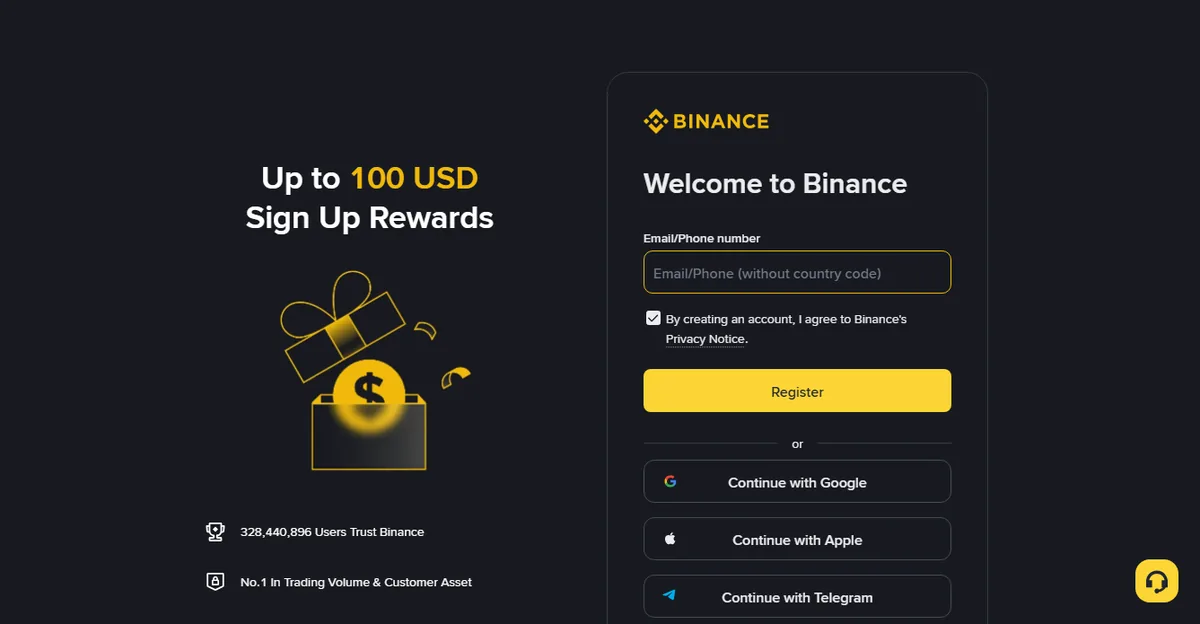
The code must go in before the account exists
The form has a field labelled Referral ID or similar. It is often collapsed behind a "Have a referral code?" link, so it is easy to miss entirely. Fill it before you press the final sign-up button.
The relationship binds the moment the account is created.
Entering the code anywhere afterwards will, in almost every case, do nothing. This catches a lot of people, who sign up, then find a guide, then discover codes exist.
If that is you: do not delete and re-register. Opening a second account as the same person triggers risk controls, and the downside (verification stuck, account restricted) is far worse than the fee difference. Carry on with the account you have.
A link with the code already in it is less error-prone
Typing the code by hand invites mistakes: letter O against digit 0, letter I against digit 1, indistinguishable in some fonts. A referral link fills the field for you; all you do is confirm it shows up.
Our referral code is BI27XB92. Open the sign-up page through the link below and the referral field arrives pre-filled. Just check it reads BI27XB92 before you submit.
Check first whether your region is eligible. Binance restricts affiliate promotion in a number of places, currently understood to include the United States, the EU/EEA, the United Kingdom, Singapore and Hong Kong. Readers there are not covered by the offer on this page and should not sign up through this link. That scope changes, so what Binance shows on its own sign-up page and terms at the time is what governs. This link carries a referral parameter. It costs you nothing extra. Signing up with the code gets you up to 20% off trading fees*. * That discount covers spot, margin and futures fees; stock trading is charged as a platform fee and is not included. The actual rate is whatever Binance displays at the time and can change.
Small things on the sign-up form
Use a password you have not used anywhere else. Crypto accounts are among the most heavily credential-stuffed targets on the internet, and a password leaked from some unrelated site is an open door.
Phone or email? Both work, but email survives changing numbers and moving countries. If either is plausible for you, email saves future hassle.
When it asks for your country or region, answer honestly. A mismatch between this and the document you later submit is a straightforward path to failed verification.
Verification: what to prepare, and the four things that fail
This is the gate. Until verification passes, no stocks tab, no P2P, effectively nothing.
What you need
- A valid government document: passport, national ID or licence, depending on what your jurisdiction supports;
- A device with a working camera for the liveness check;
- Even lighting. Not a single overhead lamp at midnight.
When we walked through this, the time sink was not the form. It was re-shooting the document. Four failure modes account for most of it.
One: glare, or corners outside the frame
Laminated documents under a lamp produce a white blowout right across the number or the name. The fix is not more light, it is different light: lay the document flat, move yourself slightly off-axis so the reflection does not bounce back into the lens, or work near a window. All four corners must be inside the frame, because the system checks border integrity.
Two: name order or spelling not matching
This trips up more people than it should. Passports print surname and given names separately; some people fill the form in the order they say their name aloud, some systems expect the opposite.
Middle names, diacritics and hyphens can all break the comparison.
The safe method is mechanical: copy from the machine-readable zone character by character. Whatever order the document uses, use that. Change nothing.
Three: the liveness check fails
It asks you to turn your head, blink, or read digits. Failures are usually environmental: glasses throwing reflections, a window behind you, movements too fast to track, or somebody walking through frame. Move somewhere with light coming from the front, take the glasses off, slow down.
Four: the document expires soon
Some documents get rejected for insufficient remaining validity even though they have not expired. If yours has only a couple of months left, renew first rather than passing verification and being asked to resubmit shortly after.
Do not use somebody else's documents
Borrowing a relative's ID creates a dead end at withdrawal, at any account appeal, and at inheritance: the account name and the bank name will not match, and the money may simply be unreachable. In most jurisdictions it carries legal exposure on top of that.
If verification does come back rejected, we mapped each system message to the specific thing to change in a separate piece.
Verification passed. Two things before you fund anything
Most people go straight to depositing. Give it ten minutes first. Crypto accounts are rarely lost because an exchange was breached. They are lost because individual account protection was thin.
Turn on 2FA, and not only SMS
SMS codes can be defeated by SIM-swap attacks. Prefer an authenticator app, and add a hardware key if you can. When you set up the authenticator, write the backup key down on paper. Lose the phone with only the app and you cannot recover.
Set the anti-phishing code
Underused and genuinely effective. Once configured, every legitimate email Binance sends you carries a string you chose. Any message claiming to be from Binance without that string goes straight in the bin, no judgement call required.
This takes thirty seconds and removes an entire category of attack. Phishing mail has got good enough that inspecting sender addresses is no longer reliable.
While you are in there: withdrawal address whitelist
With it on, withdrawals can only go to addresses you added in advance. Even if somebody gets into the account, they cannot send funds to themselves. The cost is a waiting period when you add a new address later. Worth it.
Getting money in
Stock orders settle in USDC. You can place orders holding USDT or BNB and the system converts at submission, but somewhere upstream you need stablecoin.
How you get it depends heavily on where you are. Three broad routes:
- P2P. You buy stablecoin from another user with local currency; Binance escrows their coin and handles disputes. Available payment rails vary by country and change over time, so go by what the page actually shows when you open it, not by any guide's screenshot, including ours.
- Local fiat rails. Some regions have direct deposit options. Whether yours does is visible in your own account.
- Transferring stablecoin in from elsewhere. If you already hold it, just send it. Match the network on both ends and test with a small amount first. Coins sent on the wrong chain are generally gone.
The full P2P walkthrough is in its own piece: how to pick a counterparty, and which three sentences should make you cancel immediately. It deserves the space; the risk on that leg is real and mostly avoidable.
When you get stuck
Everything above is how the steps go when they go right. Here is what to do when they do not.
Verification was rejected
Start with the message the system gave you. Most of the time it names the item that failed, and re-shooting that one item is the whole fix.
If it keeps failing, try a different document type, or try again at a different hour — when the review queue is busy, borderline cases fail more readily.
Do not resubmit repeatedly. Several attempts in quick succession trigger a rate limit, which makes you slower, not faster. Change one thing, submit once, wait.
There is no stocks section in the account
Work through it in this order: does verification actually read "approved" rather than "under review"; is the app on its current version, because an older client will not show a new entry point; and is your jurisdiction in scope.
If all three check out and you still cannot see it, switch the app's interface language, clear the client cache, then sign out and back in. Whether the entry point renders is affected by both language and cache, and this step works for more people than you would expect.
The full sequence has its own page: the four layers to check when the stocks section is missing. If this is where you are stuck, work through that one.
The name on your bank account does not match
The name receiving payment on the P2P leg has to be the same person as the name on your verified account.
Paying from a family member's card will most likely get the order flagged. Settle this before you open the account rather than arguing it afterwards — an appeal costs far more of your time than picking the right account did.
What this route saves you, and what it does not have
If you were going to buy US stocks anyway, the real question is how this compares with the route you would otherwise take.
What it removes is the paperwork barrier
Opening an account with an international broker typically means proof of address, a bank account in an accepted jurisdiction, sometimes a tax identification number, and funding by wire. For someone already inside that system, none of it is hard. For someone outside it, each item is a wall.
This route swaps the problem: no foreign bank account required, but you do need to be comfortable acquiring stablecoin. The barrier moves from "do you have the right banking relationship" to "can you handle P2P".
The cost shape is different, so "zero commission" is not the comparison
Brokers usually charge per order or per share, and some advertise commission-free while recovering it in FX or platform fees.
Here commission genuinely is zero, replaced by a platform fee that punishes small orders and flattens out to 0.1% above the hinge.
And there is a cost that appears on no fee schedule: the rate at which your local currency became a dollar-denominated asset. Bank FX is a published spread. P2P is a matched market price, and that spread widens when markets are stressed. It is real money and it belongs in the total.
What is genuinely thinner here
Established brokers have spent years building order types, research tooling, and tax documentation. What you get here is a leaner stock trading feature. If your needs go beyond buy, hold and sell, whether that means complex orders or complete year-end statements, check item by item against what is actually offered rather than assuming parity.
One structural point too: your shares sit with a US-licensed broker while your account relationship sits with Binance. That is one more link than opening directly with a broker. More links is not the same as unsafe, but it is a factor you would not otherwise have to think about. We take that chain apart in the risk-structure piece.
After the account is open
You are buying real shares. The path runs: you place the order in the Binance app, it is routed by Nest Trading (a Binance entity regulated in ADGM, Abu Dhabi, acting as introducing broker) to Alpaca, a US-licensed broker that handles execution, clearing, settlement and custody. That settlement runs in USDC and that fractional shares are supported are both stated on Binance's own stocks product page. Both names are checkable. The ADGM register record for Nest Trading Limited (FSRA number 260000, registered 5 January 2026, status Active when we checked in September 2026) carries one restriction worth reading yourself: it is not permitted to hold or control Client Money. That is the regulatory side of the same fact as Binance not custodying your securities. Alpaca's side of the chain is described on its Broker API page, whose footer states that securities brokerage services are provided by a FINRA/SIPC member entity. You are the beneficial owner, you receive dividends, you participate in corporate actions.
Separately, Binance also runs bStocks, a tokenised equity product on chain. That is a different thing with different rules. Do not conflate the two.
Selling does not immediately free the cash. US equities settle T+1. Until settlement completes, USDC from a sale can be used for spot or to buy more stock, but cannot move to a futures account, cannot be withdrawn, cannot go to fiat trading. A lot of people discover this after selling. The full timeline is in the settlement piece.
Sessions are not what you may be used to. Regular hours are 9:30 to 16:00 US Eastern, with a 24/5 arrangement on top and some tickers trading 24 hours. Across time zones this is easy to get wrong, and liquidity outside regular hours is thinner, with wider spreads.
Dividends are withheld at source. Non-US holders are generally subject to US withholding on dividends; those who qualify can claim a treaty rate via a W-8BEN-type form. Which rate applies depends on your tax residency and the relevant treaty, and varies enormously between people. The IRS page on Form W-8BEN is the authoritative source; we walk through the mechanics in the dividends piece.
For the current value of any specific fee or limit, Binance's fee schedule is the only authoritative place, and stocks sit on their own tab there. The fee figures here were checked in August 2026, and Nest Trading’s registration status was re-checked in September 2026; fee structures change without much notice.
Common questions
I forgot the referral code when signing up. Can I add it now?
Almost certainly not. The referral relationship binds when the account is created and entering the code later does not usually take. If you have already signed up, do not delete and re-register to fix it. A second account from the same person triggers risk controls, and that costs more than the fee difference ever would.
How long does verification take?
When it goes smoothly it is automated and comes back quickly. Binance's help page puts review at typically within 48 hours. When it routes to manual review it slows down noticeably and varies with the backlog, so do not schedule your account opening for the day you want to trade.
Why is there no stocks tab in my account?
Check three things first: whether verification actually passed rather than being still in review, whether the app is on the latest version, and whether your jurisdiction is in scope. If all three are fine, try switching the app interface language, clearing the cache and restarting, since feature entry points can be affected by client language and cached layout.
Does the referral code make buying stocks cheaper?
No. The fee discount from a referral code applies to spot, margin and futures trading fees. Stock trading runs on zero commission plus a platform fee and is not covered. Where the code is worth something to you is the spot side, buying USDC for instance.
What documents do I need?
A phone number or email that can receive codes, a valid government document, and a device with a working camera for the liveness check. The name on the document has to match what you type exactly, including middle names and the order they appear in.