Account · Eligibility
Can non-US residents buy US stocks? The four checks that decide it
The US side is the easy part. The answer usually comes from where you live and which platform you use.
WHAT THIS COVERS
- The US side: no passport check, just a W-8BEN
- US sanctions: Iran, Cuba and North Korea, and what changed for Syria
- If you live in the EU: shares yes, US-domiciled ETFs usually no
- If you live in the UK: the KID rule is being replaced, and the ETF answer is not settled
- If you live in India: it goes through the LRS limit
- If you live in mainland China: every route is closed
- The platform decides last
Yes. No US law requires a shareholder to be a US citizen or to live in the US, and a US broker asks a non-US person for one extra form, the W-8BEN. Whether you can buy is a different question, and the answer usually comes from closer to home: US sanctions, the rules of the country you live in, and the list of countries your platform accepts.
Most answers online stop at "anyone can buy US stocks". That is true of the US side and says nothing about the other three. Four questions, in this order, get you a real answer:
- Does the US let you hold the shares? (Tax paperwork only.)
- Are you in a place the US sanctions? (Then the answer is almost always no.)
- Does your own country let money leave for foreign shares, and does it let retail investors buy the product you want?
- Does the platform accept residents of your country for its stocks product?
The US side: no passport check, just a W-8BEN
When a US broker onboards someone from abroad, it is not asking what passport you hold. It is asking whether you are a "US person" for tax. The IRS form that answers that for individuals is the W-8BEN, the Certificate of Foreign Status of Beneficial Owner.
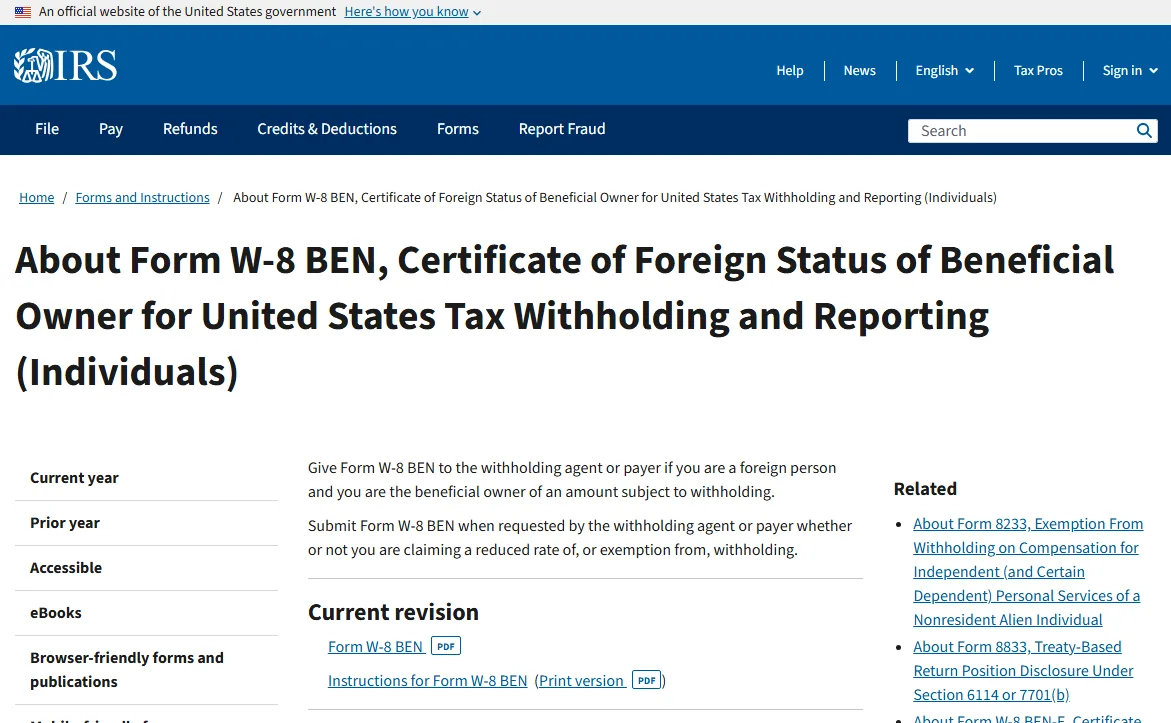
The form instructions add three details people tend to skip:
- You do not send it to the IRS. It goes to the broker or payer that asked for it.
- If you are asked for it and do not provide it, payments can be withheld at 30% or fall under backup withholding.
- You sign it "under penalties of perjury". The country of residence on it has to be the one you actually live in.
The W-8BEN does not decide whether you may buy. It decides how much tax comes off your dividends (see dividend withholding and W-8BEN) and how a sale is treated (see tax on US stock gains for non-residents).
US sanctions: Iran, Cuba and North Korea, and what changed for Syria
Your shares end up held by US brokers and clearing firms, and they have to follow sanctions administered by the Treasury's Office of Foreign Assets Control. On OFAC's list of sanctions programs, Iran, Cuba and North Korea each have a program named after the country. If you live in one of them, expect to be stopped at the country-of-residence field.
Syria is no longer in that group. Executive Order 14312, signed on 30 June 2025, ended the country-wide program with effect from 1 July 2025. What remains on OFAC's list is a program aimed at people tied to the former Assad government. Platforms maintain their own country lists, though, and a change in US law does not mean every platform has updated. The registration screen is the place to check.
If you live in the EU: shares yes, US-domiciled ETFs usually no
The EU restriction is about the product, not the person. The PRIIPs Regulation (EU) No 1286/2014 requires the maker of a packaged investment product to produce a Key Information Document before offering it to retail investors (Article 5), and requires whoever sells or advises on it to hand that document to the retail investor (Article 13). ETFs are in scope.
Most US fund companies do not produce an EU-format KID. France's markets regulator, the AMF, notes in its guidance on US products that the Regulation is not binding on US managers. So an EU broker will typically block a retail order for an ETF domiciled in the US.
Where the rule stops:
- Individual shares are not PRIIPs. Apple or Nvidia stock is not affected.
- For the same index exposure, look for a UCITS ETF domiciled in Ireland or Luxembourg. Those come with a KID.
- Clients classified as professional under MiFID II are outside the retail rule, but brokers set a high bar for that classification.
If you live in the UK: the KID rule is being replaced, and the ETF answer is not settled
The UK kept its own copy of PRIIPs after leaving the EU, and is now swapping it for a regime the FCA calls Consumer Composite Investments. According to FCA policy statement PS25/20, the legislation started on 6 April 2026, with an optional transition until the rules take full effect on 8 June 2027. Once they apply, distributors must not sell a CCI to a retail client without an up-to-date product summary.
Whether US fund companies will produce UK product summaries, and so whether US-listed ETFs open up to UK retail accounts, is something we could not confirm. During the transition, your broker's order screen is the practical answer. Individual US shares are unaffected either way.
If you live in India: it goes through the LRS limit
Indian residents can buy foreign shares, but the money leaves under the Reserve Bank of India's Liberalised Remittance Scheme. The RBI's LRS FAQ sets the ceiling at USD 250,000 per person per financial year (April to March), covering permitted current and capital account transactions together, so overseas share purchases count against it. The same FAQ rules out sending money abroad for margin calls. Tax collected at source also applies to these remittances; the rate and threshold have changed more than once, so ask your bank when you send.
If you live in mainland China: every route is closed
This one is short. The foreign exchange regulator's guidance on personal currency purchases lists securities investment abroad among the uses that are not permitted. A plan issued by the CSRC and seven other agencies on 22 May 2026 bars overseas brokers from opening accounts or taking orders for mainland investors, and gives existing account holders two years in which they may only sell and withdraw. A 2021 central bank notice already treats overseas crypto exchanges serving mainland residents as illegal financial activity. The channel the regulators point to is QDII funds. These rules are about residents of the mainland: a Chinese citizen living abroad is governed by the rules where they live.
The platform decides last
Clear all of the above and the platform still has to accept you. A common mistake is to assume that "I can open an account here" means "I can buy US stocks here". They are separate lists.
On the route this site covers, Binance does not execute the stock trades itself: Nest Trading, regulated by ADGM in Abu Dhabi, sits in the middle, and the US broker Alpaca executes and holds the shares (the chain is drawn in our safety piece). Which countries get the stocks product depends on what every link in that chain is permitted to do, so it need not match the list of countries where you can register.
The practical check: can you pick your country at registration, and does the stocks entry appear once verification is done? The eligibility check walks through both. If verification passed and the entry still does not show, work through the four layers here.
Do not borrow someone else's address or identity
Opening an account with a relative's foreign address, or under their name, looks like a way round one of the layers above. It runs into three problems at once: the residence you state on a W-8BEN is declared under penalty of perjury; the platform requires the account to be opened and used by the verified person, and mismatches get accounts frozen; and legally, the money belongs to the person on the ID, not to you.