BUYING STOCKS · COST BREAKDOWN
Is zero-commission stock trading really free? The fees you still pay
"Zero commission" is true as far as it goes, but it answers only one question. Between placing an order and selling, a US stock trade can cost you in several other places: some on the fee schedule, some only when you sell, some inside the price itself.
WHAT THIS COVERS
- What "commission-free" actually waives, and what it leaves in place
- SEC and FINRA fees when you sell US stocks: the 2026 rates
- The cost no fee schedule lists: the bid-ask spread
- What payment for order flow is, and who pays a broker that charges you nothing
- Other charges that "zero" tends to hide
- How to read any broker's fee schedule, in order
Not entirely. "Zero commission" removes one line from your bill: the per-trade commission. When you sell a US stock, two regulators, the SEC and FINRA, each levy a small fee that your broker is allowed to pass on to you. The bid-ask spread and any currency conversion never appear on the fee schedule; they are baked into your fill price. And some platforms charge a per-order or percentage fee under a different name, such as "platform fee" or "trading spread".
None of these is large on its own. Together they set the real cost of a small order. This page sorts them into what is printed on the fee schedule, what only shows up when you sell, and what hides inside the price, with the official source next to each figure.
What "commission-free" actually waives, and what it leaves in place
A commission is the fee a broker charges for executing your order, traditionally a few dollars per trade. Plenty of US brokers now charge $0 commission on online stock trades. Many of them still have a line on the fee schedule that does much the same job under another label.
Binance's stocks fee schedule is a good example (checked October 2026). Nothing on it is called a commission. The "Trading & Account" table says:
- Orders of $340 and below: a Platform Fee of $0.35, shown as $0.17 during a promotion;
- Orders of $340 and above: a Trading spread of 0.10%, shown as 0.05% during the promotion;
- Both promotions are marked "Until 2026-12-31 23:59 (UTC)".
So when two "free" platforms look alike, ignore the label and work out what you pay per $100 traded. At the standard rate, a $100 buy costs $0.35, or 0.35%. At the promotional $0.17 it is 0.17%. A broker charging a flat $1 commission would take 1% of the same order. To run your own amount, use the order cost calculator, which uses the standard $0.35, so during the promotion you would actually pay less than it shows.
SEC and FINRA fees when you sell US stocks: the 2026 rates
Both of these apply to sales only. Nothing is charged when you buy. The regulators bill the broker, and the broker decides whether to pass the charge through or absorb it.
SEC transaction fee: $20.60 per million dollars sold
This comes from Section 31 of the Securities Exchange Act. The SEC's fee rate advisory of 27 February 2026 sets the rate for most securities transactions at $20.60 per million dollars of sales from 4 April 2026. For sales up to 3 April 2026 the rate was $0.00.
In retail terms, selling $5,000 of stock works out to 5,000 × 20.60 ÷ 1,000,000, about $0.10. A $100,000 sale is about $2.06. The rate is recalculated each fiscal year from the SEC's appropriation, so the next change will arrive as a new advisory.
FINRA Trading Activity Fee: charged per share, paused October to December 2026
FINRA's Trading Activity Fee (TAF) is based on the number of shares sold, not their value. FINRA's September 2026 rule filing SR-FINRA-2026-021 shows the standard rate: $0.000195 per share sold, capped at $9.79 per trade.
The filing itself is a pause. Trades between 1 October and 31 December 2026 are assessed at $0.00, and the standard rate returns on 1 January 2027.
Because it counts shares, the TAF matters more for cheap stocks traded in bulk. Selling 200 shares comes to 200 × 0.000195 = $0.039. You would need to sell a little over 50,000 shares in one trade to reach the $9.79 cap. On half a share the figure rounds to nothing, and whether a broker rounds it up to a cent is the broker's own policy.
Will either fee actually reach your account?
In the same filing FINRA notes that clearing firms commonly pass the TAF straight on to the customers who submit the orders, and that the pass-through usually appears on the customer's trade confirmation. It also says practice varies with each firm's business model.
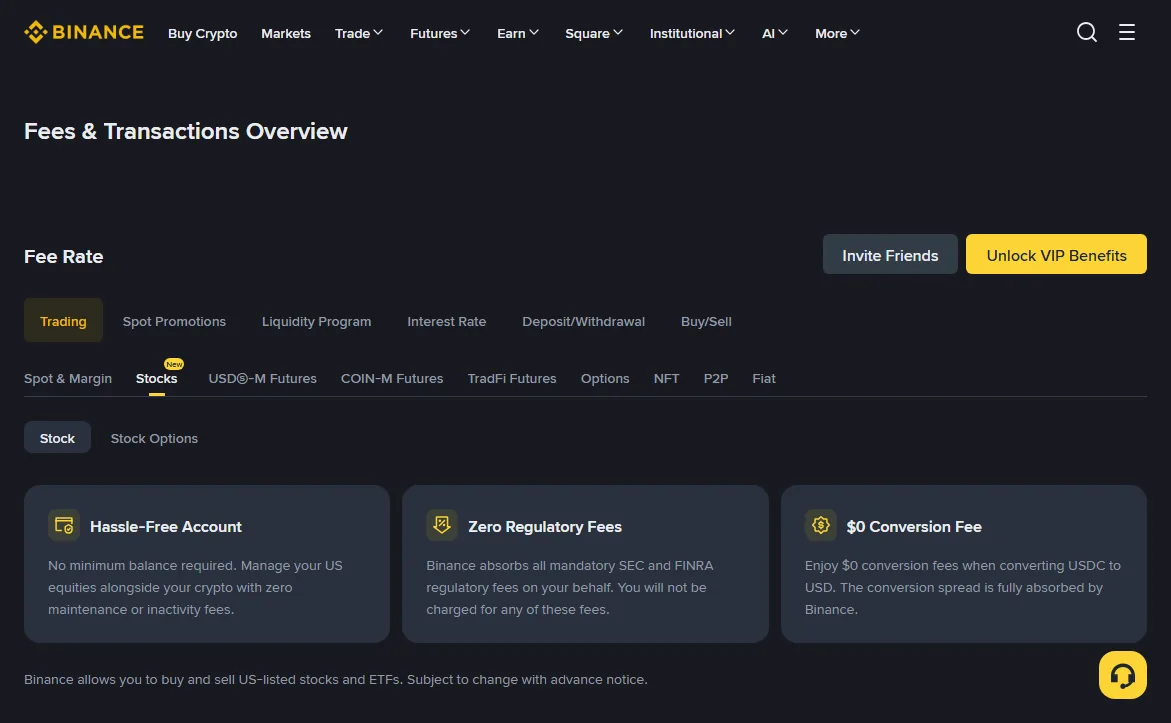
So check two places: the fee schedule, for a "regulatory fees" or "sell side only" section, and the confirmation you get after a sale. Binance's schedule lists the SEC fee, the FINRA TAF and the Consolidated Audit Trail (CAT) fee at "$0.00, absorbed by Binance". A note at the bottom adds that these rates are set by the authorities, may change without notice from Binance, and are "currently" absorbed. The word "currently" is theirs.
The cost no fee schedule lists: the bid-ask spread
At any moment a stock has a best bid and a best ask. Say the bid is $49.99 and the ask is $50.01. A market buy fills at $50.01; an immediate market sell fills at $49.99. The round trip loses two cents a share, and that loss is on no statement anywhere.
How wide the gap gets depends on how many people are trading. It is narrowest in regular hours and noticeably wider pre-market, after hours and overnight; a limit order puts a ceiling on the price you accept. The full cost breakdown and the trading hours guide cover that side. What matters here is how the spread connects to "zero commission".
What payment for order flow is, and who pays a broker that charges you nothing
Payment for order flow (PFOF) means a broker sends retail orders to a market maker for execution, and the market maker pays the broker for them. The market maker is willing to pay because it earns from the spread. PFOF is one of the revenue sources most often cited for US commission-free brokers.
It is not a fee charged to you, and you will not see it on a statement. The question it raises is a different one: where did your order go, and was the fill price good?
How to look up a US broker's order flow payments: the Rule 606 report
Rule 606 of Regulation NMS requires every broker-dealer to publish a quarterly report on how it routes customer orders. The report must go up within one month after the quarter ends, on a website that is free and readily accessible to the public, and stay there for three years. For each significant venue it shows the net payment for order flow received, split by market orders, marketable limit orders, non-marketable limit orders and others, both as a total and per share.
To find one, open the broker's Disclosures page and look for "606", or search for the broker's name plus "606 report". Then read two things: which market makers received the orders, and whether the "net payment received" figures are positive or zero. Positive means the broker takes PFOF. That alone does not tell you whether your fills were good, but it is the hardest public evidence of where a zero-commission broker's money comes from.
The bottom of Binance's fee page says stock trading services are provided by Nest Exchange Limited, with clearing and custody by Alpaca Securities LLC, a US broker-dealer and FINRA/SIPC member. The full chain is mapped in the safety guide. Alpaca, as a US broker-dealer, publishes its own 606 report, but the page does not say whether orders arriving through Nest are all counted in it.
If your broker is EU-regulated, PFOF is now banned
Article 39a of the EU's Markets in Financial Instruments Regulation (MiFIR) bars investment firms serving retail or professional clients from taking any fee or benefit from a third party for executing those clients' orders, or for forwarding them to a particular venue. The article allowed member states where the practice existed before 28 March 2024 to exempt their own firms, but only until 30 June 2026 (ESMA's rulebook page).
From July 2026, then, an EU-licensed broker cannot fund "zero commission" with order flow payments. The cost has to show up somewhere else, which makes the per-order and percentage lines on its schedule the ones to read first.
Other charges that "zero" tends to hide
Where a US stock trade can cost you money, and where each charge becomes visible
| Charge | When it applies | Where you can see it |
|---|---|---|
| Commission, or a renamed platform fee or trading spread | Every buy and sell | First table on the fee schedule |
| SEC transaction fee | Sales only | Regulatory fees section; trade confirmation |
| FINRA TAF | Sales only, per share | Same as above |
| Bid-ask spread | Every trade, worst with market orders in thin hours | Only in the fill price |
| Currency conversion | Whenever your funding currency is swapped for dollars | The conversion quote; currency section of the schedule |
| ADR fees | Holding depositary receipts of non-US companies | Fee schedule; account history (Binance lists $0.01–$0.05 per share as a pass-through) |
| Outgoing transfer | Moving your shares to another broker | "Others" section (Binance lists $150 per security per submission, ACATS not supported) |
Conversion often costs more than the platform fee, because the money you fund with is rarely dollars to begin with. On Binance, USDC to USD is listed at $0.00 with the spread absorbed, while USDT, BNB and others are first converted to USDC at the market spread. USDC or USDT works through which one costs less.
How to read any broker's fee schedule, in order
- 1Find the per-order or percentage lineCommission, platform fee, service fee, trading spread: whatever it is called, convert it to cost per $100 for one small and one large order.
- 2Look for an end dateIf a rate carries "Promotion until" or similar, note the date. After it, the standard price applies.
- 3Find the sell-side regulatory feesAre they passed through or absorbed? If absorbed, check for words like "currently" or "subject to change".
- 4Find the conversion and transfer-out linesThe first sets what each trip in and out costs you; the second sets the price of leaving later.
- 5If you want to go further, open the 606 reportUS broker-dealers only. It answers where the money comes from, not whether a given fill was good.
Put a $300 sale through that list. At current rates the SEC fee is about $0.006, and the TAF on three shares is under $0.001, or zero for trades in the last quarter of 2026. The platform fee on the same order is $0.35 at the standard rate. For a small retail account, regulatory fees barely register; the first line of the schedule and the conversion line are where platforms really differ. Regulatory fees only start to matter at tens of thousands of dollars or shares in a single trade.
When each of these numbers is due to change
Binance's $0.17 platform fee and 0.05% trading spread are promotional and marked to end at 23:59 UTC on 31 December 2026. FINRA's TAF pause covers trades from October to December 2026 only, with the fee back from 1 January 2027. The SEC fee is reset by a new advisory each fiscal year. If you are costing a trade around the turn of the year, check those three first.
For how per-share charges land when an amount-based buy leaves you holding a fraction of a share, see the fractional shares guide.